Measure it
The wash-day count: measuring shedding the way clinicians do
The short answer
It is normal to shed up to about 50 to 100 hairs a day 12. To track shedding on treatment, pick one method and repeat it the same way each week: either a wash-day count modelled on the dermatologist's modified wash test 3, or a standardised 60-second comb count 4. The trend over weeks matters, not any single number.
Why count at all?
Shedding feels enormous when you are anxious about it. A count turns "it's falling out everywhere" into a number you can compare with last week. It is especially useful during a treatment shed, because the pattern described for minoxidil, a rise in the first weeks followed by a fall 5, only becomes visible when you write numbers down.
Method 1: the wash-day count
This is a home version of the modified wash test, a method published by dermatologists at the University of Genoa. In their study, 100 patients washed their hair in a sink in a standardised way, every shed hair was collected and counted, and hairs were sorted by length 3. A later study found the method reliable when repeated weekly for four weeks 6.
How to do it at home
- Keep the gap the same. Always count on a wash that comes the same number of days after your last wash, for example always three days. Hairs that would have fallen build up between washes, so a changing gap changes the count.
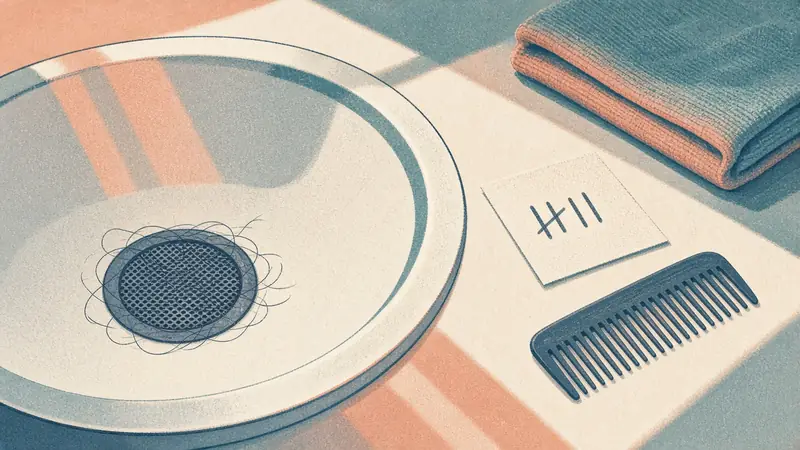
- Catch everything. Use a mesh drain cover or a piece of gauze over the plughole. Wash and rinse as normal.
- Collect and count. Gather all hairs from the cover, your hands and the towel. Lay them on a dark cloth or paper and count. Grouping them in tens makes it easier.
- Optional: sort by length. Separate any hairs 3 cm or shorter. In the published method, short shed hairs are treated as thin vellus hairs, and if they make up 10% or more of the total, that pointed toward pattern hair loss 3.
- Log it with the date in the private tracker.
What the numbers meant in the study
In the Genoa study, the best match with doctors' clinical diagnoses came from using 100 shed hairs as the cut-off for chronic telogen effluvium 3. That figure applies to their standardised method in a clinic. Treat your own home counts as a trend line, not a diagnosis.
Method 2: the 60-second comb count
If you do not want to collect hairs from the drain, a timed comb count is simpler. You comb your hair for one minute over a plain, contrasting surface and count the hairs that fall. The published method fixes how and when the combing is done, so at home keep your own routine identical each time. A study at Baylor College of Medicine standardised this in 60 healthy men without hair loss 4:
- Men aged 20 to 40 shed between 0 and 78 hairs, with an average of 10.2.
- Men aged 41 to 60 shed between 0 and 43, with an average of 10.3.
- Counts were consistent day to day and barely changed when repeated six months later.
That consistency is what makes the method useful for tracking. Do it at the same time of day, with the same comb, on the same day each week. Note that the normal range was set in men; use it as your own trend, not a pass mark.
Which method should you choose?
| Wash-day count | 60-second count | |
|---|---|---|
| Effort | More: collect and count every hair | Less: one minute plus counting |
| What it captures | Everything released since your last wash | A sample of loose hairs |
| Best for | Long hair, people who wash on a fixed schedule | Short hair, busy weeks |
| Evidence | Modified wash test 36 | Standardised in healthy men 4 |
Do not switch between methods. A number from one is not comparable with the other.
Reading your counts on treatment
- A rise in the first weeks on minoxidil that falls again fits the described shed 57.
- A steady line is common and fine.
- A rise months into treatment after a calm stretch points to a new trigger. See shedding came back.
- Counts that keep climbing past your treatment's window are a reason to get checked.
Seasons can move counts too. If you see a bump at the same time each year, Hair Experts covers seasonal shedding.
If your counts stay high
Persistently high counts with all-over thinning are a reason to look for a cause beyond your treatment. A clinician will often start with blood work; iron stores and vitamin D are commonly checked.
Keep going, adjust, or get checked?
Three quick questions. Your answers stay in this browser tab and are never sent anywhere.
Questions people ask
How do I count hair shed in the shower?
Catch hairs with a mesh drain cover, collect everything after washing, and count them on a dark surface. Keep the number of days since your last wash the same each time 3.
Is the 60-second hair count accurate?
In a study of 60 men it gave consistent results day to day and over six months 4.
Sources
- American Academy of Dermatology. Do you have hair loss or hair shedding? Open source
- DermNet. Female pattern hair loss. Open source
- Rebora A, Guarrera M, Baldari M, Vecchio F. Distinguishing androgenetic alopecia from chronic telogen effluvium when associated in the same patient: a simple noninvasive method. Arch Dermatol. 2005;141(10):1243-1245. Open source
- Wasko CA, Mackley CL, Sperling LC, et al. Standardizing the 60-second hair count. Arch Dermatol. 2008;144(6):759-762. Open source
- Bi L, Kan H, Wang J, et al. Whether the transient hair shedding phase exist after minoxidil treatment and does it predict treatment efficacy? A retrospective study in androgenetic alopecia patients. J Dermatolog Treat. 2025;36(1):2480739. Open source
- Guarrera M, Cardo PP, Rebora A. Assessing the reliability of the Modified Wash Test. G Ital Dermatol Venereol. 2011;146(4):289-294. Open source
- Nohria A, Desai D, Sikora M, et al. Combating "dread shed": the impact of overlapping topical and oral minoxidil on temporary hair shedding during oral minoxidil initiation. JAAD Int. 2024;15:220-224. Open source
Checked 16 November 2026. See how we set the windows.